Rainbow Gingham Digital Patterns as a Strategic Tool for Creative Projects
When you first encounter a set of Rainbow Gingham Digital Patterns, it is easy to see them as simply decorative. The cheerful grid, the spectrum of colors, the nostalgic weave of gingham reimagined in digital form. But if you work in design, branding, content creation, or any field where visual communication matters, these patterns represent something far more substantive. They are a reusable asset, a structural element for layout, and a consistent visual language that can unify a wide range of projects. Understanding how to use them intentionally rather than decoratively can change how you approach everything from a client proposal to a personal photo album.
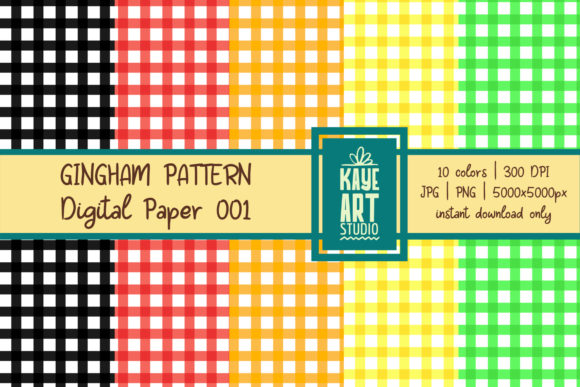
These digital papers come in both JPG and PNG formats, each file sized at 5000x5000 pixels with 300 DPI quality. That technical foundation matters because it gives you flexibility. You can scale the pattern for a full-page background, crop it for a detail accent, or layer it with other elements without losing clarity. The 10 papers in the set offer enough variety to build a cohesive system while still giving you room to differentiate each piece of work. Whether you are a small business owner creating product packaging, a scrapbooking enthusiast preserving memories, or a freelancer designing stationery sets, the strategic value lies in how you deploy these patterns across your workflow.
Why Rainbow Gingham Digital Patterns Matter for Your Work and Projects
At its core, gingham is a pattern of repetition and rhythm. The crisscross of colored and white squares creates a visual beat that is both structured and playful. When you introduce a rainbow spectrum into that structure, you gain the ability to encode meaning through color while retaining the grounding effect of the grid. This dual quality is rare in digital assets. Many patterns are either too busy to be useful for text overlays or too neutral to carry emotional weight. Rainbow gingham sits in a productive middle ground. It is engaging without being overwhelming, and it communicates warmth, nostalgia, and precision all at once.
For professionals and creators, this means you have a single asset that can serve multiple strategic functions. You can use it to establish brand recognition across different touchpoints. You can rely on it to create visual consistency in a series of invitations, social media graphics, or product labels. You can even use it as a subtle background for presentations or worksheets, adding personality without distracting from the content. The key is to treat it not as decoration but as a design system element that reinforces your goals.
Consider the entrepreneur who sells printable party kits. A set of Rainbow Gingham Digital Patterns allows them to offer coordinated designs for invitations, thank-you cards, cupcake toppers, and banner flags. Instead of searching for separate patterns for each piece, they pull from a single set, ensuring every item feels like part of the same family. This coherence builds trust with customers. It signals that the seller has thought through the experience end to end. The same logic applies to a blogger creating a series of recipe cards or a teacher assembling classroom materials. When the visual language is consistent, the message feels more intentional.
Elevating Brand Identity and Visual Communication
If you are building or refreshing a brand, the patterns you choose become part of your visual identity. Rainbow gingham, with its balance of structure and color, works especially well for brands that want to project approachability and reliability. A children's clothing line, a bakery, a stationery shop, or a lifestyle blog can all benefit from the pattern's inherent warmth. But the strategic move is not to use the pattern everywhere. It is to use it at specific moments where you want to create recognition. Perhaps it becomes the background for your product photography, the border on your business cards, or the repeating element on your website footer. Consistency in placement, not just in pattern, reinforces memory.
When you have both JPG and PNG versions of each design, you gain additional control. The PNG format with its transparency allows you to overlay the pattern on photographs, colored backgrounds, or existing designs without awkward white edges. This is particularly useful for digital invitations or social media graphics where you want the pattern to blend seamlessly with other visual elements. The JPG version, on the other hand, gives you a solid, high-quality file that works beautifully for print projects where you need a full background or a standalone element. Having both formats means you do not have to compromise between digital flexibility and print fidelity.
Streamlining Creative Workflows with Consistent Assets
Time is a scarce resource for any creator or small business owner. Every minute spent searching for a new pattern, testing its resolution, or adjusting its colors is a minute not spent on higher-value work. A dedicated set of Rainbow Gingham Digital Papers streamlines that process. Because the files are already 5000x5000 pixels at 300 DPI, you know they will work for nearly any standard project size. You can drop them into your design software without resizing or interpolation concerns. This predictability allows you to move faster from concept to completion.
Think about a freelancer who designs custom photo albums for clients. They might use different gingham colors to represent different sections of the album. A rainbow gradient could denote the start of a new chapter, while a single-color gingham grounds a memory page. Because the patterns are from the same set, the album feels intentionally designed rather than pieced together from disparate sources. The freelancer saves time on sourcing and editing, and the client receives a more polished product. That efficiency translates into better margins and higher customer satisfaction.
Enhancing Customer Experience in Product Offerings
If you sell digital products, your customers are often looking for ease and reliability. They want to download a file and know immediately that it will work for their intended use. When you offer Rainbow Gingham Digital Patterns as part of a kit or a standalone purchase, you are giving them confidence. The high resolution and dual format mean they can print at large sizes without pixelation, or use the PNG for layering in their own projects. This reduces support inquiries and returns, which directly impacts your operational efficiency.
Moreover, the rainbow theme invites emotional connection. Gingham carries associations of picnics, handmade crafts, and simpler times. The rainbow adds joy and inclusivity. For customers creating birthday invitations, wedding stationery, or baby shower decorations, these patterns help them tell a story. They are not just sending a piece of paper. They are setting a tone. As a seller, your role is to provide assets that make that storytelling easier. When the pattern does half the emotional work, your customer feels more capable and satisfied.
Matching Patterns to Project Goals
Not every project needs a rainbow. Not every project needs gingham. Before you open the files, clarify what you are trying to achieve. Are you creating a invitation where the pattern will be the hero element? Then choose a vibrant rainbow gingham and let it fill the frame with minimal text overlay. Are you designing a professional worksheet where the pattern should support but not distract? Then consider using a single-color variation or a muted section of the rainbow pattern as a subtle background. The flexibility of having 10 papers in the set means you can make these distinctions without buying additional assets.
For print projects like scrapbooking or photo albums, think about the physical size of your final product. A 12x12 inch scrapbook page will benefit from the 5000x5000 pixel resolution because you can print at actual size without losing sharpness. For smaller items like gift tags or stickers, you can use a smaller portion of the pattern, cropped to highlight a specific color band. The high resolution gives you the freedom to extract details without introducing blur or artifacts.
Technical Considerations for Production and Print
If you are sending these files to a commercial printer, verify that they accept JPG or PNG at 300 DPI. Most modern printers do, but some workflows prefer TIFF or PDF. In that case, you can easily convert the JPG files in any image editing software. The PNG files, with their transparency, are ideal for digital-only use or for projects where you want to layer the pattern over another background. Keep in mind that transparent PNGs will not print correctly on all consumer printers without a solid backing layer. If you are printing at home, consider using the JPG version on white cardstock for the most reliable result.
Another technical point worth planning for is color consistency. Rainbow gingham patterns contain a wide gamut of hues. Different monitors and printers interpret color differently. If color accuracy is critical for your project, do a test print on your intended paper stock before producing a large batch. This is especially important for commercial products where customers will compare the printed item to their screen view.
Setting Clear Objectives Before Choosing Patterns
It is tempting to start a project by choosing a pattern you like and then building around it. That approach can work, but it often leads to mismatched elements and last-minute adjustments. A more effective strategy is to define your objectives first. Ask yourself: What emotion or message do I want this project to convey? Who is the audience, and what will they do with this piece? What other visual elements will be present? Once you have answers, you can select the specific gingham pattern that reinforces those goals.
For example, if you are creating a set of invitations for a pride event, the full rainbow gingham is a natural fit. If you are designing a set of thank-you cards for a wedding, you might choose a pastel version or a section of the pattern that features softer tones. The same set of 10 papers can serve both purposes if you plan ahead. By mapping each pattern to a specific use case, you avoid the trap of using the same design for everything and diluting its impact.
Building a Cohesive Collection Across Multiple Assets
One of the strongest arguments for investing in a set like this is the ability to create a cohesive collection. Imagine you are launching a line of printable stationery. You can use one gingham pattern for the letterhead, a complementary pattern for the envelope liner, and another for the coordinating stickers. The rainbow theme ties them together, but the variation keeps each piece interesting. This kind of collection feels professional and curated, which directly supports your positioning as a serious creator or business.
For scrapbookers, the same principle applies to a two-page spread or an entire album. You might use a full rainbow gingham as the base page and then mat your photos on a neutral gingham pattern from the same set. The repetition of the grid structure creates visual harmony, while the color shifts provide gentle differentiation. This approach is far more intentional than randomly selecting patterns from different sources.
Common Pitfalls and How to Avoid Them
Using Rainbow Gingham Digital Patterns without clear goals can lead to several problems. The most common is visual clutter. Gingham is a strong pattern, and when paired with other busy elements, it can overwhelm the viewer. If your project already has multiple photographs, text blocks, or decorative elements, consider using the pattern as a small accent rather than a full background. A border, a corner detail, or a strip across the top can add charm without competing for attention.
Another risk is color clash. Even within a rainbow set, the specific shades may not align with your existing brand colors or the palette of your photographs. Before committing to a pattern, test it against your other materials. If the blue in the pattern is cooler than your brand blue, the mismatch will be noticeable to a trained eye. In digital products, you can often adjust the color in software, but for printed work, the pattern is fixed. Choose the variation that harmonizes best, or accept the rainbow as a dominant color statement that overrides other hues.
A third pitfall is overuse. When a pattern appears in every piece of a product line without variation, it starts to feel repetitive rather than cohesive. The viewer becomes desensitized to its effect. To maintain impact, vary the scale, rotation, or placement of the pattern across different items. Use it large on one piece, cropped on another, and as a thin border on a third. The consistency comes from the shared visual language, not from identical application.
Long-Term Value of Investing in High-Quality Digital Assets
A set of Rainbow Gingham Digital Patterns at 5000x5000 pixels and 300 DPI is not a disposable asset. If stored properly, these files will remain usable for years. The resolution is high enough to accommodate future printing needs, including larger formats or higher-quality presses. The dual format ensures compatibility with both current and future software. This longevity is especially valuable for businesses that maintain a consistent brand identity over time. You can use the same pattern on a website in 2025 and on a catalog in 2030 without having to recreate or relicense it.
Additionally, owning a complete set gives you the freedom to experiment. You can try the patterns in contexts you did not initially anticipate. Perhaps you discover that a rotated gingham pattern makes an interesting texture for a social media graphic. Or that a cropped section works beautifully as a logo background. The more you work with the set, the more applications you will find. This compound creativity is the real return on investment for a well-chosen digital asset.
Ultimately, Rainbow Gingham Digital Patterns are a tool for intentional design. They are not a shortcut to good results, but they are a reliable foundation. When you pair them with clear objectives, thoughtful planning, and a willingness to edit, they can elevate your work across scrapbooking, stationery, invitations, printables, and beyond. The patterns themselves are colorful and cheerful. The strategy behind their use is what makes them effective.