Garden Seamless Patterns: A Practical Guide to Getting the Most from Your Digital Design Assets
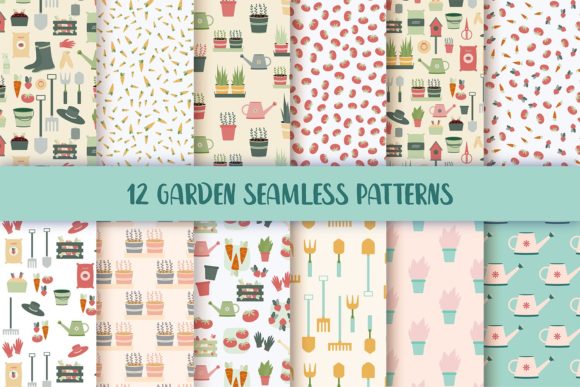
When you invest in a set of garden seamless patterns, you are not just buying a collection of pretty digital papers. You are acquiring a versatile toolkit that can transform everything from packaging and textile print to apparel design, surface design, blog design, branding, website backgrounds, scrapbooking, papercraft, greeting cards, gift tags, canvas bags, and home decor. A well-crafted set, such as one containing 12 gardening seamless repeat vector patterns, offers enormous creative potential. Yet many creators, from beginners to seasoned professionals, make preventable mistakes that limit the quality, usability, and impact of these assets. This guide walks you through the most common pitfalls and provides straightforward, practical advice to help you use garden seamless patterns effectively and confidently.
Understanding What a Garden Seamless Pattern Set Actually Delivers
A garden seamless pattern is a repeating design that tiles flawlessly, without any visible seams, across any surface. A quality set typically includes digital papers in multiple file formats to accommodate different workflows. For instance, a comprehensive product might provide 12 high-resolution JPG files at 300 DPI, 12 PNG files at 300 DPI with transparent backgrounds, and 12 fully editable EPS vector files, each at 2000x2000 pixels. This combination gives you both ready-to-use raster images and scalable vector art for Adobe Photoshop and Adobe Illustrator.
The real value lies in the flexibility. You can drag and drop a pattern into your project immediately, or you can open the EPS file in Illustrator, adjust colors, resize elements, and create custom variations without losing any detail. Understanding this distinction is the first step toward getting the most out of your purchase.
Mistake 1: Confusing Raster and Vector Formats and Misusing Them
One of the most frequent misunderstandings is treating PNG and JPG files as if they were infinitely scalable. Raster files are pixel-based. Even at 2000x2000 pixels and 300 DPI, they have a fixed resolution. If you enlarge a raster pattern beyond its native size, you will see pixelation, and the crispness of your design will suffer. This is especially problematic for large-format applications like textile print, home decor, or canvas bags, where the pattern needs to cover a sizable area without degradation.
The vector EPS files, by contrast, are resolution-independent. They are built from mathematical paths, not pixels. You can scale them to the size of a postage stamp or a billboard, and they will remain perfectly sharp. The mistake is using the raster versions for large-scale work and then wondering why the quality falls short.
The better approach: Use the JPG or PNG files for digital projects where the pattern stays at a predictable size such as blog backgrounds, social media graphics, or small papercraft items. For any project that requires scaling up, or where you need to edit colors and elements, open the vector EPS files in Adobe Illustrator. This preserves the integrity of the design and gives you total control. If you do not use vector software, you can still benefit from the high-resolution raster files, but be mindful of your output dimensions.
Mistake 2: Overlooking the 300 DPI Requirement in Real Projects
DPI, or dots per inch, is a measure of print resolution. The industry standard for high-quality print is 300 DPI. Many digital papers claim to be 300 DPI, which is excellent, but some beginners mistakenly reduce the DPI to 72 or 150 to make files smaller or to speed up their software. This is a critical error if you are producing packaging, greeting cards, gift tags, or apparel. At lower DPI, printed patterns appear soft, blurry, or pixilated.
The JPG and PNG files in a proper garden seamless pattern set are already set to 300 DPI, which means they are ready for professional print use. The mistake is not checking the DPI setting before sending a file to a printer or uploading it to a print-on-demand service. Many platforms automatically downsample images, and if you do not verify your settings, your final product may look disappointing.
The better approach: Before you place a pattern into any print layout, confirm that your document is set to 300 DPI. If you scale the pattern down in your design software, the effective DPI increases, which is fine. But if you scale it up too much, the effective DPI drops. Always keep your final output dimensions in mind. For digital-only use, such as website backgrounds or blog design, lower DPI is acceptable, but for anything physical, stick with 300 DPI from the start.
Mistake 3: Ignoring the Transparency Advantage of PNG Files
A common oversight is using JPG files when a transparent background would make the design process much smoother. JPG is a lossy format that does not support transparency. Every JPG has a solid white or colored background, which can create awkward white rectangles when you place the pattern over another color or image. This becomes a problem in scrapbooking, papercraft, layered greeting cards, or any design where the pattern needs to blend with a background.
The PNG files with transparent backgrounds solve this problem elegantly. You can layer them over other colors, textures, or photographs without any harsh edges. This gives you far more creative flexibility and saves time because you do not have to manually remove backgrounds.
The better approach: Whenever you are placing a pattern on top of another element, use the PNG version. Keep the JPG files for projects that require a solid background or for thumbnails and previews. If you are working in Adobe Photoshop, using the PNG file with transparency allows you to apply blending modes, layer styles, and masks to create unique effects that a JPG simply cannot support.
Mistake 4: Neglecting to Test Scale and Proportion Before Finalizing
A garden seamless pattern that looks perfect on your screen at 100% zoom may feel overwhelming or too small when applied to a physical product. Scale is one of the most underestimated factors in surface design. A pattern with large floral elements might be stunning on a wallpaper but look chaotic on a gift tag. Conversely, a pattern with tiny, detailed motifs might get lost on a large canvas bag.
Another aspect of this mistake is failing to preview the pattern on a mockup. When you see a pattern isolated on a white screen, it is easy to misjudge how it will behave on a curved surface, a folded card, or a textured fabric. Designers who skip this step often end up with products that feel off, and they cannot always pinpoint why.
The better approach: Create simple mockups in your design software or use free online mockup generators to test how the garden seamless pattern looks at the actual size of your intended product. Scale the pattern up or down until the proportions feel natural. For a set of 2000x2000 pixel patterns, you have plenty of resolution to work with, but you must adjust the scale to suit the application. A good rule of thumb is to print a small test swatch or view the pattern at 100% on a screen that matches your output size. Your eyes will tell you if something is too big or too small.
Mistake 5: Choosing a Pattern Without Considering Your Brand or Project Color Palette
Garden seamless patterns come in a wide variety of color schemes. Some are bright and vibrant, others are muted and vintage. A common mistake is falling in love with the design itself and ignoring whether the colors align with your brand identity or project palette. This can lead to a disjointed look, especially in branding, packaging, and blog design, where consistency is crucial.
When you invest in a vector EPS file, you have the ability to edit colors in Adobe Illustrator. This is a significant advantage that many users overlook. Instead of searching for a pattern that exactly matches your colors, you can choose a pattern with a strong composition and adjust the hues to fit your needs. Not all pattern sellers provide editable vectors, so when you have them, you should use them.
The better approach: Before you start designing, define your color palette. Then review the garden seamless patterns in your set and identify which ones have a composition that works for your project. Open the EPS file in Illustrator and adjust the colors using global swatches or direct selection. This gives you a custom pattern that looks intentional and professional, rather than an off-the-shelf design that clashes with your other elements. If you do not use Illustrator, you can still use the high-resolution raster files, but you will be limited to the original colors, so choose carefully.
Mistake 6: Forgetting to Check the Seamless Quality Before Heavy Use
Not all seamless patterns are created equal. Even a well-made set can have subtle issues that become visible only after the pattern is repeated across a large area. The most common problems are visible seam lines where the pattern does not tile perfectly, or repeating motifs that form an obvious grid. These issues can ruin a professional presentation, especially in textile print, wallpaper, or packaging.
Many users apply a pattern and assume it is flawless because it looks good in a small preview. They do not zoom out or create a larger repeating block to inspect the seams. By the time the problem is discovered, it may be too late to fix without starting over.
The better approach: When you first open a garden seamless pattern file, create a quick test in your design software. Tile the pattern across a large canvas, at least 3 by 3 repeats, and zoom in on the edges to check for any misalignment, color shifts, or odd gaps. Pay attention to areas where leaves, stems, or flowers touch the border of the tile. A quality set will have clean, invisible seams, but it is always wise to verify. This small step saves you from costly printing errors and ensures that your final product looks polished.
Practical Advice for Evaluating a Garden Seamless Pattern Set Before Purchase
If you are shopping for a set like the one described here, look for clear information about file formats, resolution, and dimensions. A product that lists 12 JPG files at 300 DPI, 12 PNG files at 300 DPI with transparent backgrounds, and 12 vector EPS files at 2000x2000 pixels is transparent about what you receive. Avoid sets that are vague about file specs or that only offer low-resolution previews.
Also, consider the subject matter. Garden seamless patterns with natural motifs such as flowers, leaves, vines, herbs, and botanical illustrations are versatile across many industries. They work well for organic brands, eco-friendly packaging, spring and summer apparel, home decor with a nature theme, and educational materials. The more neutral and balanced the palette, the broader the applications.
Finally, think about your own workflow. If you primarily use Adobe Photoshop, the PSD-compatible JPG and PNG files will serve you well. If you work in Adobe Illustrator or need to customize colors and scales, the editable EPS files are essential. A set that offers both gives you the best of both worlds and ensures that you are covered regardless of the project.
Bringing It All Together
Garden seamless patterns are a powerful resource for creators at every level. They save time, provide consistency, and open up creative possibilities that would be difficult to achieve from scratch. But getting the best results requires a little knowledge and attention to detail. By understanding the difference between raster and vector formats, respecting DPI requirements, using transparency wisely, testing scale and proportion, matching colors to your palette, and verifying seamless quality, you can avoid the common mistakes that lead to frustration and wasted effort.
Whether you are designing packaging for a small business, creating digital content for a blog, or crafting handmade greeting cards for an Etsy shop, a well-selected set of garden seamless patterns can elevate your work. Take the time to choose the right file format for each task, preview your patterns in context, and use the vector files to customize colors when needed. Your designs will look more professional, your workflow will feel smoother, and you will get the most value from your investment. Have fun, experiment with different combinations, and let your creativity grow.