Terrazzo Seamless Patterns: A Practical Guide for Design Selection
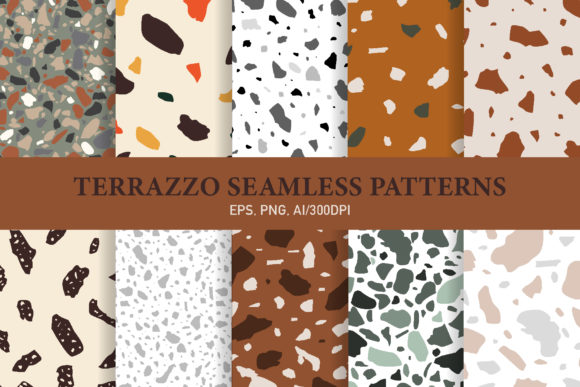
When evaluating surface design options, Terrazzo Seamless Patterns offer a distinctive combination of texture, color, and repeatability that appeals to a wide range of creative and commercial applications. Originally derived from traditional Venetian flooring, modern terrazzo patterns have evolved into versatile vector assets suitable for digital and print use. This guide helps you assess whether these patterns align with your project needs, weighing benefits against tradeoffs and clarifying what to expect when working with 10 EPS, AI, and PNG seamless patterns.
What Terrazzo Seamless Patterns Offer
Terrazzo seamless patterns are digitally created or scanned textures that simulate the look of aggregate chips set in a binder, arranged in a way that repeats without visible seams. The 10 pattern collection typically provides a variety of color palettes, chip sizes, and densities, giving you options for different aesthetic directions. Because the files are delivered in EPS, AI, and PNG formats, they are compatible with most design software and can be scaled, recolored, or combined with other elements. The seamless nature makes them suitable for flooring mockups, branding assets, packaging, stationery, textiles, wallpaper, and more, without the need for manual tile alignment.
Why Consider Terrazzo Patterns for Your Next Project
Interest in terrazzo often stems from its ability to bridge vintage and contemporary styles. The speckled appearance adds visual depth without overwhelming a layout, making it a popular choice for backgrounds, accent panels, and product finishes. If you are evaluating patterns for consistency, scalability, or production efficiency, seamless terrazzo files reduce the risk of visible repeating units—a common headache when working with non-seamless textures. Additionally, the range of 10 variations allows you to test different moods, from muted monochromes to bold multicolored chips, before committing to a final look.
For designers working on branding or packaging, terrazzo can provide a tactile, material-like feel in digital or printed form without the cost of actual terrazzo fabrication. This makes it a practical asset for mockups, client presentations, and short-run projects where material sampling is impractical.
Benefits and Practical Advantages
- Seamless repeatability: The patterns tile across any surface without interruption, saving time on manual alignment and reducing waste in digital or printed layouts.
- Vector and raster flexibility: EPS and AI files allow infinite scaling and color editing, while PNG files offer immediate use in web, presentation, or non-vector workflows.
- Versatile application range: Whether you are designing flooring concepts, wrapping paper, fabric prints, or social media templates, the same pattern set can adapt to both large-format and small-scale uses.
- Consistent aesthetic across media: Because the patterns are pre-made and tested for seamlessness, you can maintain a uniform look across packaging, stationery, and branding collateral.
- Time savings for tight deadlines: Having a curated set of 10 patterns eliminates the need to create from scratch, allowing faster iteration and client approval.
Tradeoffs and Considerations
While terrazzo seamless patterns are highly functional, they are not a one-size-fits-all solution. The visual complexity of chip patterns can clash with minimalist or ultra-clean design languages, especially if the chips are large or high-contrast. In branding applications, overuse of terrazzo might dilute a brand’s distinctiveness if the pattern becomes too generic or reminiscent of popular design trends. For flooring and interior use, digital patterns are approximations—they simulate the look but do not replicate the texture, depth, or light reflection of real terrazzo. If you need a physically accurate material preview, a photographic or 3D texture may be more appropriate.
Another tradeoff lies in the number of patterns. A set of 10 offers variety, but may not cover every color scheme or chip distribution you desire. You may find yourself needing to recolor or combine patterns, which is possible with vector files but requires additional software skills. If you are not comfortable with Adobe Illustrator or similar tools, the PNG files are more limited in editability.
Scenarios Where Terrazzo Patterns Are a Strong Fit
- Branding and packaging for lifestyle products: The pattern adds a handmade, material quality that complements organic, artisanal, or retro-modern brands.
- Stationery and paper goods: Notebooks, cards, and wraps benefit from the visual texture without increasing production complexity.
- Textile and fashion prototypes: Seamless terrazzo can be printed on fabric or used as a digital mockup for scarves, bags, or upholstery.
- Wallpaper and interior accents: For feature walls or small-area applications, the pattern offers depth without overwhelming.
- Packaging design where material simulation matters: When you want to convey a terrazzo-like feeling without actual terrazzo costs, these patterns bridge the gap.
When Alternatives May Be Worth Considering
- High-resolution product photography needed: If your project requires true-to-life material rendering, consider photographic textures or 3D scanned terrazzo.
- Minimalist or monochrome brand identity: Terrazzo’s inherent noise may conflict with clean, sans-serif-heavy layouts.
- Extensive customization required: If you need precise control over chip color, size, ratio, or distribution, creating a custom seamless pattern from scratch gives more flexibility than any pre-made set.
- Large-scale corporate or institutional branding: The trend cycle for terrazzo may date quickly in environments where timelessness is prioritized over current aesthetics.
- Color-critical printing projects: While vector files are color-accurate on screen, final print results depend on printer calibration, paper stock, and ink profiles—test thoroughly before production.
Practical Decision-Making Insights
When choosing among the 10 patterns, evaluate them first in actual scale. A pattern that looks balanced on a screen may appear too dense or sparse when applied to a packaging box or a large wallpaper panel. Use the vector files to resize chips if needed, but be aware that disproportionate scale changes may break the seamless effect or alter the intended look. For print projects, request a physical proof from your printer using the PNG or EPS file to verify color and repeat.
Consider how the pattern interacts with other design elements. Terrazzo works well as a background, but for foreground text or icons, ensure sufficient contrast. If your branding relies on transparency, layer the pattern cautiously—it can muddy readability. For flooring or interior applications, think about scale and lighting. A pattern that works in a digital rendering may feel different in a real room; use mockup tools to simulate the actual environment.
For users who are not experienced with vector editing, the PNG files are immediately usable in most presentation, web, and print software. However, if you anticipate future color changes, branding updates, or multi-size adaptations, investing time in learning basic vector tools will pay off. The EPS and AI files are fully editable, so you can treat them as a starting point rather than a final product.
How to Evaluate Quality in Terrazzo Seamless Patterns
Not all seamless patterns are created equal. Look for files where the repeat edges are genuinely invisible—some lower-quality sets show visible lines or density shifts at tile boundaries. Test the pattern by duplicating it two or three times side by side in your software. If the aggregate distribution looks consistent across the seam, the pattern is production-ready. Also, check the chip detail at different magnifications. In vector files, chips should be composed of well-defined shapes, not pixelated or overly simplified blobs. For PNG files, resolution matters. A set with 300 DPI is adequate for most print uses, while 72 DPI may limit you to screen applications.
Is This Set Aligned With Your Goals?
If your objective is to add a flexible, on-trend texture to your design toolkit without heavy customization, a collection of Terrazzo Seamless Patterns in EPS, AI, and PNG formats is likely a practical investment. It suits fast-paced projects, multi-disciplinary work, and situations where consistency across different media matters. If your project demands exact material fidelity, total creative freedom, or a minimal aesthetic, you may find better results with alternative assets or custom creation. Ultimately, the decision hinges on how much flexibility you need versus how much you want a ready-to-use solution. For the majority of branding, packaging, stationery, and interior design applications, these patterns offer a reliable balance of quality and convenience.
By focusing on the pattern’s role in your overall design system—rather than treating it as a standalone decoration—you can integrate it meaningfully and avoid the pitfall of trend-driven choices that may not serve your long-term goals. Evaluate each pattern against your specific context, test in real-world conditions, and treat the vector files as a foundation you can build upon. This thoughtful approach ensures that whatever path you choose, your final design will feel intentional and effective.